














Introduction
Rolex has unveiled two exceptional new watches for 2026, bringing together precious metal innovation, rare dial craft and the quiet authority of a manufacture that rarely moves without purpose.
The new releases are the Oyster Perpetual Day-Date 40 in a newly developed 18 ct Jubilee Gold alloy, and an Oyster Perpetual Cosmograph Daytona in Rolesium, combining Oystersteel and platinum for the first time on this model.
These are not ordinary additions to the catalogue. They are statements.
One speaks in the language of prestige, gold and stone. The other in speed, ceramic, enamel and platinum. Both remind us that at the highest level of watchmaking, material is never only material. It is memory, status, ambition and engineering given physical form.

Yours truly...
A New Gold for the Day-Date 40
The first of Rolex’s two exceptional 2026 watches is the Day-Date 40 in Jubilee Gold, a new 18 ct gold alloy conceived, developed and produced in-house by Rolex.
Jubilee Gold is described as having tones of tender yellow, warm grey and soft pink. This places it somewhere between familiar precious-metal languages. It is neither simply yellow gold nor rose gold, and not the cold restraint of white metal. Instead, it seems designed as an effect: a gentle glow rather than a single colour.
For the Day-Date, this is appropriate.
The Day-Date has always been one of Rolex’s most prestigious watches. Launched in 1956, it was the first calendar wristwatch to display both the date and the day of the week written in full in a window at 12 o’clock. Over time, it became associated with political figures, directors, visionaries and men of influence, earning the famous nickname “the presidents’ watch”.
There are watches that ask for attention.
The Day-Date assumes it.
Light Green Aventurine and Diamond Hour Markers
The new Jubilee Gold case is paired with a bright light green aventurine dial. Aventurine, a natural stone from the quartz family, gives the dial depth and natural shimmer. On this model, Rolex adds an hour circle of ten baguette-cut diamonds.
This is an important choice because the Day-Date is not a watch of utility alone. It is a watch of ceremony. Its purpose is not to time a dive, a race or a climb. Its purpose is to carry authority with elegance.
The light green aventurine gives the piece a celestial softness. It is luxurious, certainly, but not flat. It has life inside it. Like old stone under candlelight, it changes according to the eye and the hour.
The watch is fitted with a fluted bezel and the President bracelet, both essential parts of the Day-Date language. The bracelet, made here in 18 ct Jubilee Gold, includes a concealed Crownclasp and ceramic inserts inside the links, designed to reduce premature wear and improve flexibility on the wrist.
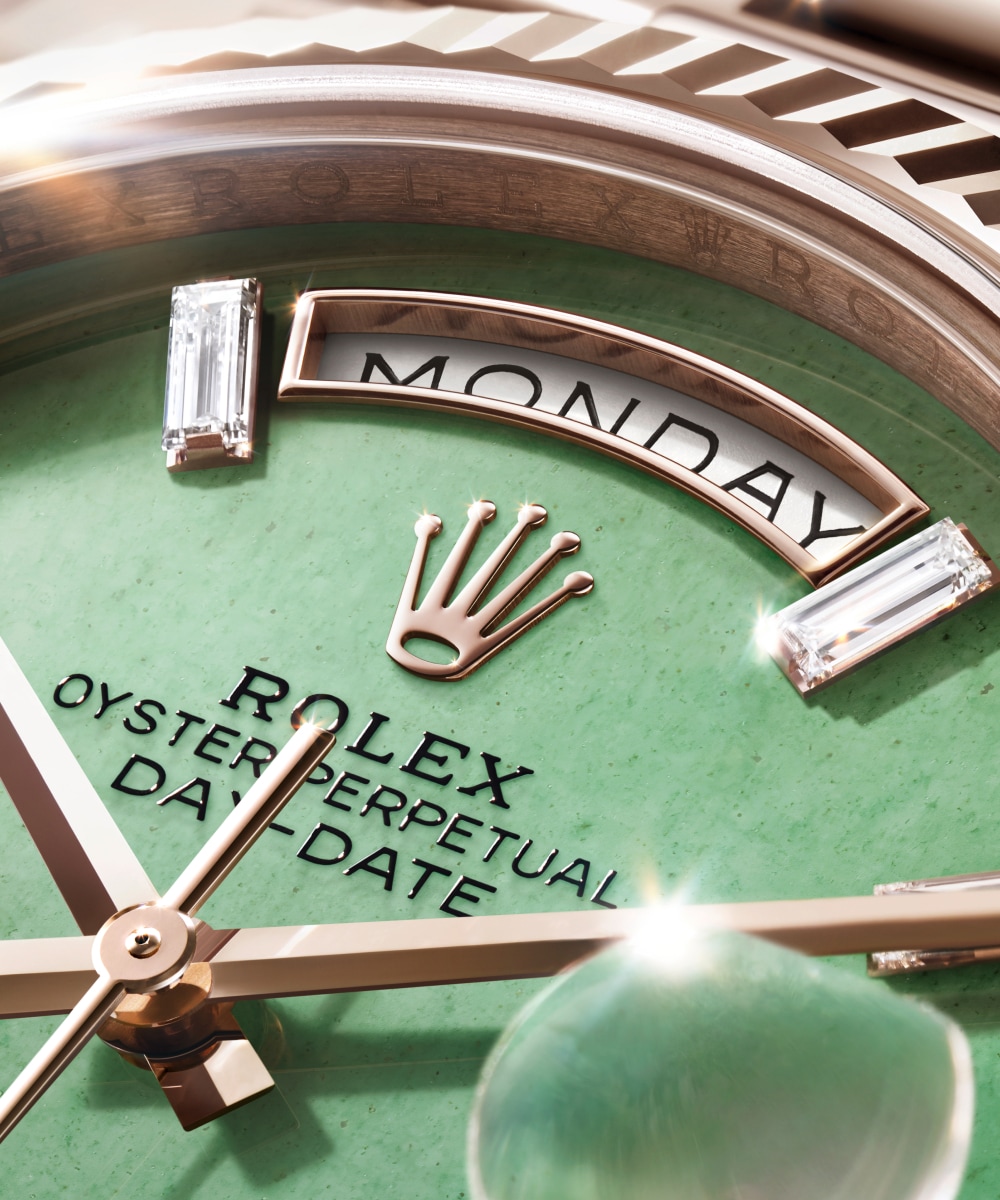
Close-up of the light green aventurine dial; Oyster Perpetual Day-Date 40, 18 ct Jubilee Gold ©Rolex/Stojan
Calibre 3255: The Discipline Beneath the Prestige
Inside the Day-Date 40 is Rolex calibre 3255, a self-winding mechanical movement developed and manufactured by the brand.
It displays the day, date, hours, minutes and seconds, and offers approximately 70 hours of power reserve. The movement includes Rolex’s Chronergy escapement, made from nickel-phosphorus and resistant to strong magnetic fields. It also features a blue Parachrom hairspring, Rolex overcoil, Paraflex shock absorbers and automatic winding by Perpetual rotor.
In simple terms, this is Rolex doing what Rolex does best: hiding serious engineering beneath a surface of complete calm.
The Day-Date in Jubilee Gold may glow like a jewel, but it remains a machine of precision. That is the secret of the best Rolex watches. They do not choose between beauty and reliability. They insist on both.
The Cosmograph Daytona Enters Rolesium
The second exceptional 2026 release is a new Cosmograph Daytona in Rolesium, combining Oystersteel and platinum. This is the first time the Daytona has appeared in this material configuration.
Rolesium has long been associated with the Yacht-Master, but here it gives the Daytona a new personality: colder, sharper and more technical. The case and bracelet are mainly Oystersteel, while platinum is used for the ring around the transparent case back and the metal band surrounding the Cerachrom bezel.
The result is a Daytona that feels both familiar and strange. Its racing spirit remains, but the material language has shifted. This is not the loud glamour of yellow gold or the stealth wealth of full platinum. It is a hybrid creature — steel for strength, platinum for nobility.
A fitting combination for a chronograph built around speed and control.
White Grand Feu Enamel Dial and Anthracite Cerachrom Bezel
The dial is white enamel, produced using the grand feu technique. This traditional method involves firing enamel at extremely high temperature, over 800°C, to create a hard, luminous surface. For this Daytona, Rolex developed a special process in which the enamel is applied to ceramic plates for the dial and counters, later fitted to a brass base.
This is not merely decorative. Enamel has a particular permanence. It resists the ordinary ageing of many dial finishes and carries a depth that paint rarely achieves.
Around the dial sits an anthracite Cerachrom bezel, a new shade for this model. Rolex developed a specific ceramic made from zirconia enriched with tungsten carbide, creating a metallic effect. The tachymetric scale has also been redesigned, with horizontal numerals that echo the original 1963 Cosmograph Daytona, but in a contemporary font.
This is an intelligent historical gesture.
The watch looks backward without becoming old.
It remembers 1963, but it does not dress like it.
Calibre 4131 and the Visible Machine
The new Daytona is powered by calibre 4131, Rolex’s self-winding chronograph movement. It measures elapsed time through the chronograph function while displaying the hours, minutes and seconds.
The movement uses a column wheel and vertical clutch for precise chronograph operation. It also features Rolex Côtes de Genève decoration and, on this version, a cut-out oscillating weight made in yellow gold. The power reserve is approximately 72 hours.
Most importantly for collectors, this Daytona features a transparent sapphire case back.
Rolex does not often reveal its movements, and when it does, the decision carries weight. The case back allows the owner to see the finishing and architecture of calibre 4131 — a rare invitation from a brand that usually keeps its mechanical secrets behind closed metal.
For a Daytona, this matters.
The watch has always been linked to engines, circuits and timing under pressure. Showing the movement gives the legend a visible heart.
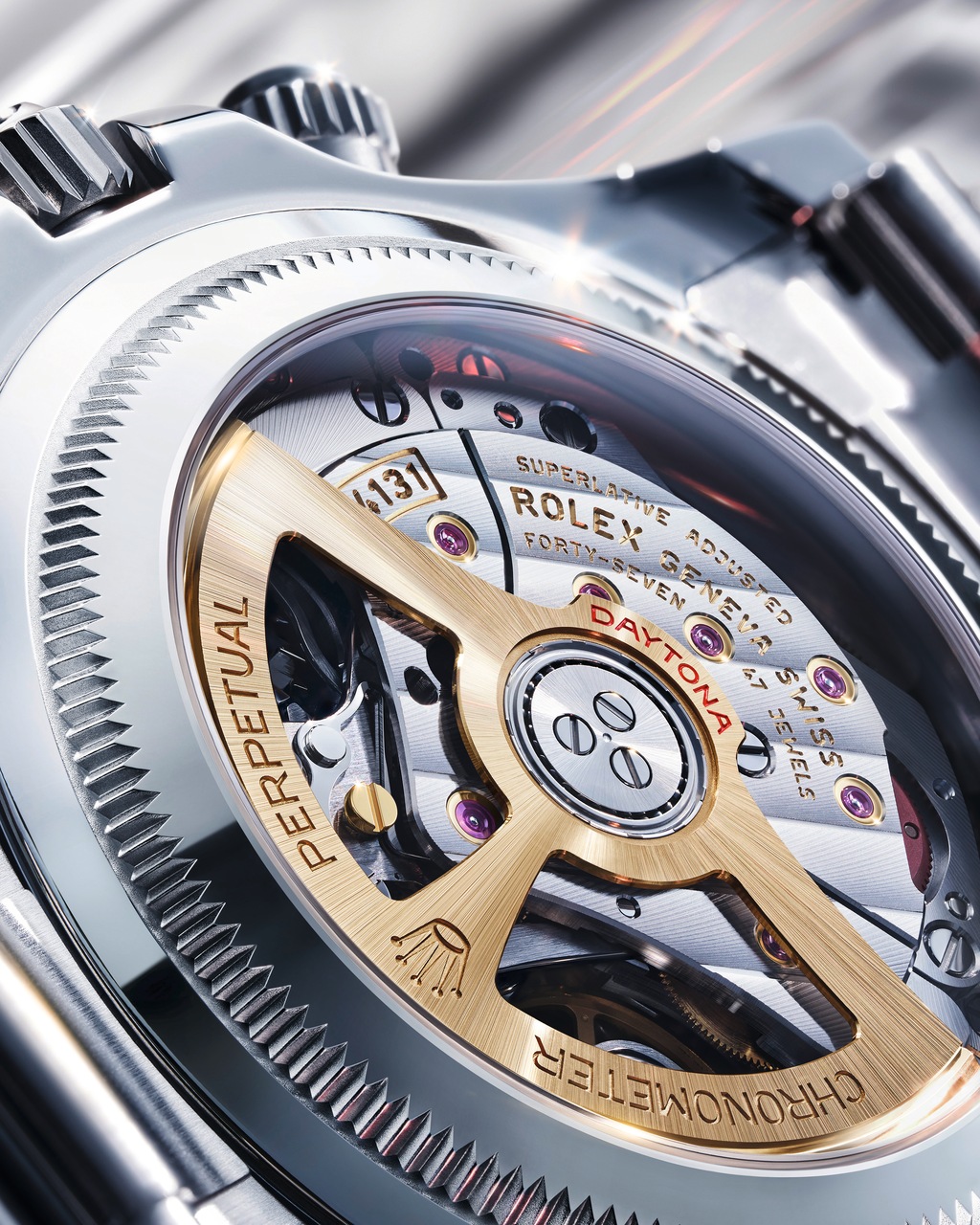
Transparent case back; Oyster Perpetual Cosmograph Daytona, Oystersteel and platinum ©Rolex/Stojan
Superlative Chronometer Certification Strengthened for 2026
Both watches carry Rolex’s Superlative Chronometer certification. For 2026, Rolex has strengthened this standard by adding three new testing criteria: resistance to magnetism, reliability and sustainability.
These join the existing requirements around precision, waterproofness, self-winding and power reserve. Rolex states that the precision of the finished watch, after casing, must fall within -2/+2 seconds per day. The certification is symbolized by the green seal and paired with a five-year international guarantee.
For collectors, this is more than marketing language.
Luxury may attract the eye, but certification reassures the hand. A watch of this level must not merely impress when new. It must continue to perform when novelty has faded.
Vampirsky View: Gold, Speed and the Desire to Endure
The Day-Date 40 in Jubilee Gold and the Rolesium Cosmograph Daytona represent two very different expressions of Rolex power.
The Day-Date is power at rest. It is prestige, inheritance, authority and ceremony. The new Jubilee Gold alloy softens its presence without weakening it, while the aventurine dial adds depth and a touch of the night sky.
The Daytona is power in motion. It is speed disciplined by measurement, racing history refined through modern materials. The white enamel dial, anthracite ceramic bezel and visible calibre 4131 give this version a rare mixture of tradition and technical boldness.
Together, these watches show Rolex expanding its language without abandoning its grammar.
That is the old Crown’s strength. It does not usually tear down its own temples. It changes the stone, sharpens the carvings, opens one hidden chamber, and allows the faithful to discover that something has shifted.
Mortals often mistake novelty for progress.
Rolex understands that permanence is more difficult.
And in these two exceptional watches, the brand offers two paths toward the same ancient desire: to hold time, to shape it, and perhaps, for a moment, to believe it can be mastered.