










Introduction
There are few things in this world that survive a century with their dignity intact.
I have seen crowns buried beneath mud, palaces turned into museums, family names reduced to whispers, and men who once commanded armies forgotten by their own grandchildren. Time is not cruel, precisely. It is simply honest. It keeps what has substance and erases what was merely loud.
Rolex, whether one loves or resents the weight of that name, has learned this truth better than most.
In 2026, the Crown celebrates one hundred years since the birth of the Oyster — the waterproof wristwatch that began, in 1926, a new chapter not only for Rolex, but for the very idea of the modern watch. A century later, the brand does not mark the occasion with nostalgia alone. It presents a collection that speaks of origin, refinement, performance, precious metal, racing, sailing, prestige, and that eternal human desire to make time obedient.
Of course, time is never obedient.
But a fine watch may persuade us, for a while, that it is.
The Oyster Perpetual 41: The Echo of the First Door Opening
The most symbolic piece in this new release is surely the Oyster Perpetual 41 in yellow Rolesor. Rolex presents it as a centenary tribute, and rightly so. The watch combines Oystersteel with yellow gold on the bezel and winding crown, a gesture that recalls the case elements of early Oyster watches.
There is restraint here, but also ceremony.
The slate dial is sober, almost monastic, yet it carries small green details: the Rolex name and squares around the minute track. At six o’clock, instead of the familiar “Swiss Made”, one finds “100 years”. The crown itself bears the number 100.
A mortal company might have made such an anniversary watch vulgar. A larger logo, perhaps. More shouting. More fireworks. Rolex, being Rolex, chooses a quieter form of pride.
This is not a watch that says, “Look at me.”
It says, “I was here before your grandfather was born, and I shall likely remain after your son is old.”
That is a very different kind of confidence.

Yours truly...
Oyster Perpetual 36: Letters, Colour, and Controlled Joy
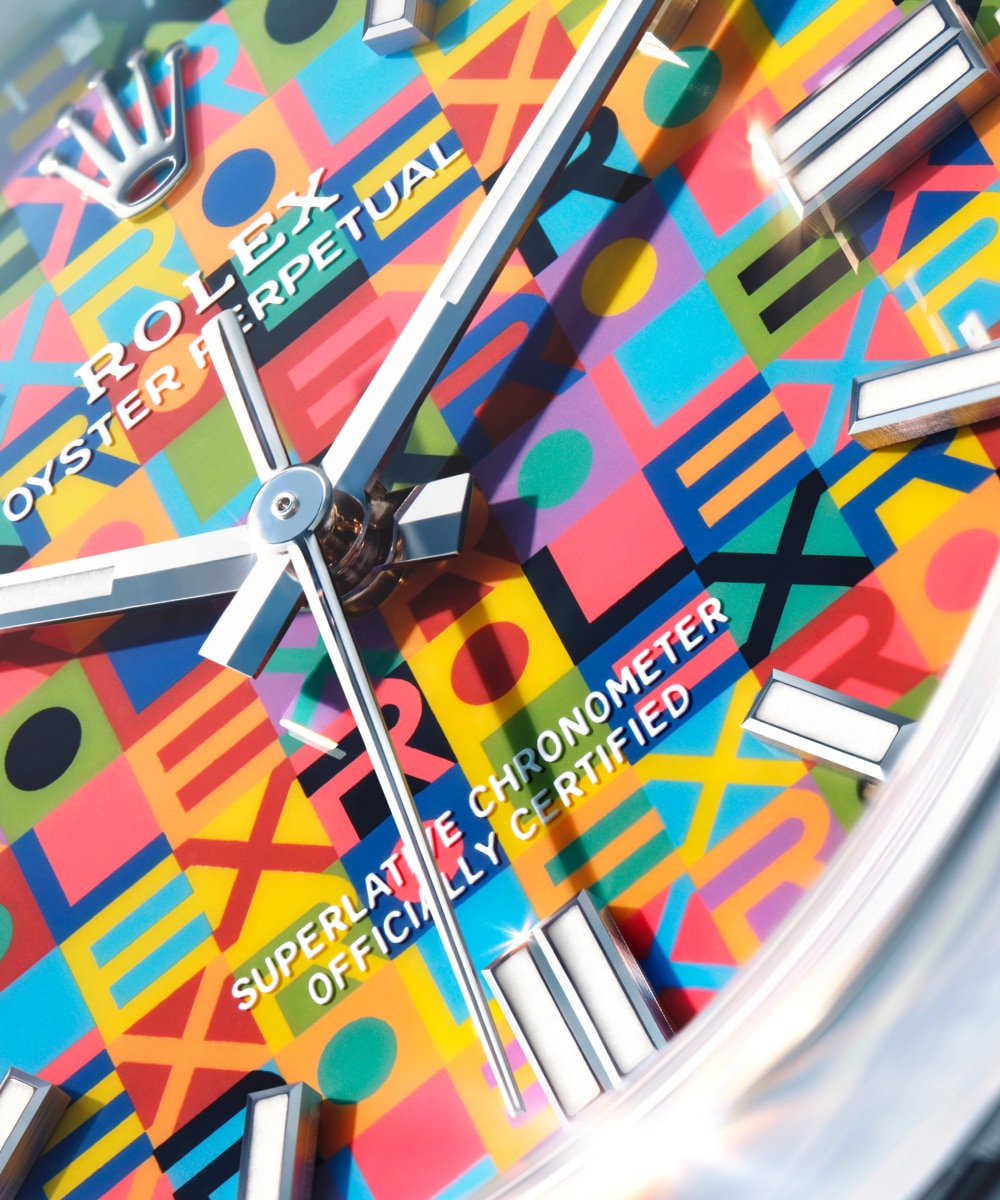
Close-up of the laquered dial with a Jubilee motif, Oyster Perpetual 36 ©Rolex/Stojan
The Oyster Perpetual 36 is the more playful creature in this nocturnal gathering. Its multicoloured lacquer dial uses the Jubilee motif, where the letters of “Rolex” form a layered composition across the surface.
At first glance, it may seem almost cheerful. But one must not confuse colour with simplicity. Each of the ten colours is applied individually by pad printing, a process requiring patience and precision. This is where Rolex often becomes interesting: beneath an apparently simple visual idea lies a difficult technical act.
I have watched painters in Venice grind pigments by candlelight. I have seen manuscript illuminators ruin their eyesight for a single letter. This dial belongs, spiritually, to that same family of obsession.
It is decorative, yes. But not careless.
And there is a difference.
Oyster Perpetual 28 and 34: Gold Learns to Whisper
The Oyster Perpetual 28 in 18 ct yellow gold and the Oyster Perpetual 34 in 18 ct Everose gold introduce a softer, more precious language to the range. One receives a green stone lacquer dial; the other, a blue stone lacquer dial. Rolex also gives these models natural stone hour markers at 3, 6, and 9 o’clock — a first for the brand.
This is fascinating.
The Oyster Perpetual has long carried the aura of the pure Rolex: simple, robust, elemental. By dressing it in gold and stone, Rolex risks disturbing that purity. Yet the result, at least in concept, is not decadence. It is intimacy.
Gold can be vulgar when it begs for witnesses.
Here, it appears more private. The satin-finished bracelet softens the precious metal, giving it texture rather than glare. These are not watches for conquest. They are watches for someone who already knows the room has noticed them, and therefore has no need to perform.
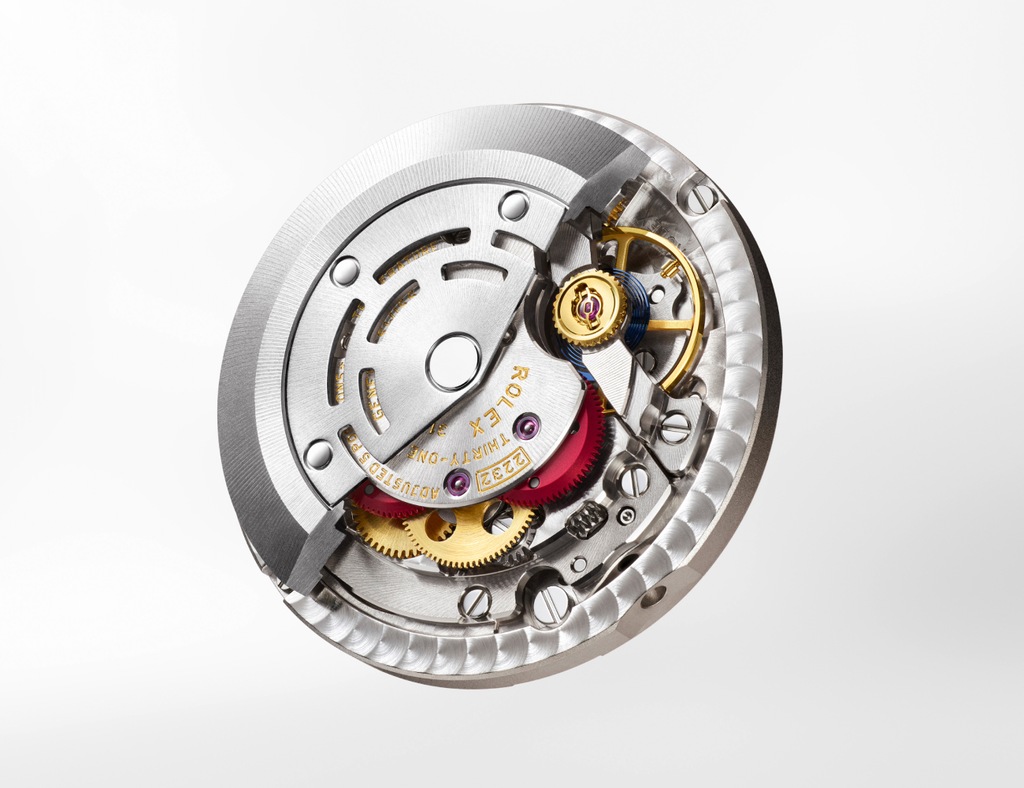
Calibre 2232 © Rolex/Ulysse Frechelin
The new-generation Yacht-Master II may be the most mechanically assertive of the 2026 announcements. Rolex has redesigned its programmable countdown function, retaining the idea of mechanical memory and on-the-fly synchronization, while simplifying the way the countdown is programmed. It is now operated through the lower pusher.
The countdown minute and seconds hands turn counterclockwise, a functional decision made possible by the new calibre 4162. The dial is cleaner, the legibility stronger, and the nautical identity sharper. The pusher geometry is inspired by winches, while the white matt lacquer dial stands against the blue Cerachrom bezel insert.
A regatta is a curious human ritual. Men place themselves against wind, water, machines, and each other, then pretend they are only racing boats. In truth, they are racing hesitation. One late decision, one poor reading of the start, and the contest is wounded before it begins.
For such a world, the Yacht-Master II makes sense. It is not romantic in the way a diver’s watch is romantic. It is strategic. It is a watch for the disciplined pulse before violence begins.