





Some inventions arrive in gold cases.
Others arrive in black plastic, with three little buttons and a beep that has haunted schoolrooms, workshops, bedrooms and airport terminals for decades.
The Casio F-91W is not a luxury watch. It was never meant to be. It does not carry itself with Swiss arrogance or mechanical romance. It is cheap, light, honest, reliable and almost impossible to dislike. It is the kind of object mankind produces only when usefulness and simplicity briefly agree not to ruin each other.
And now, through Ollee Watch, this old digital survivor has learned new tricks.
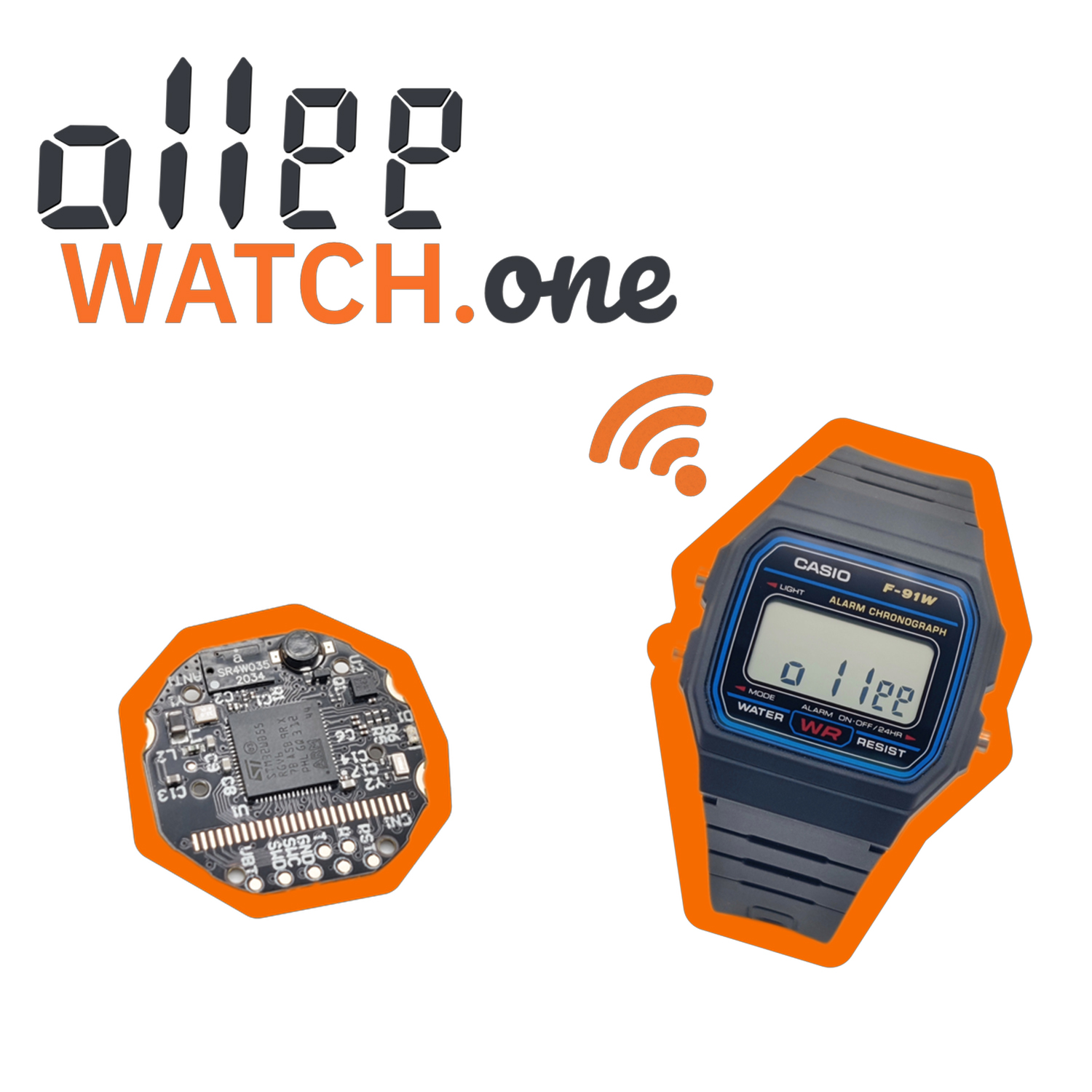
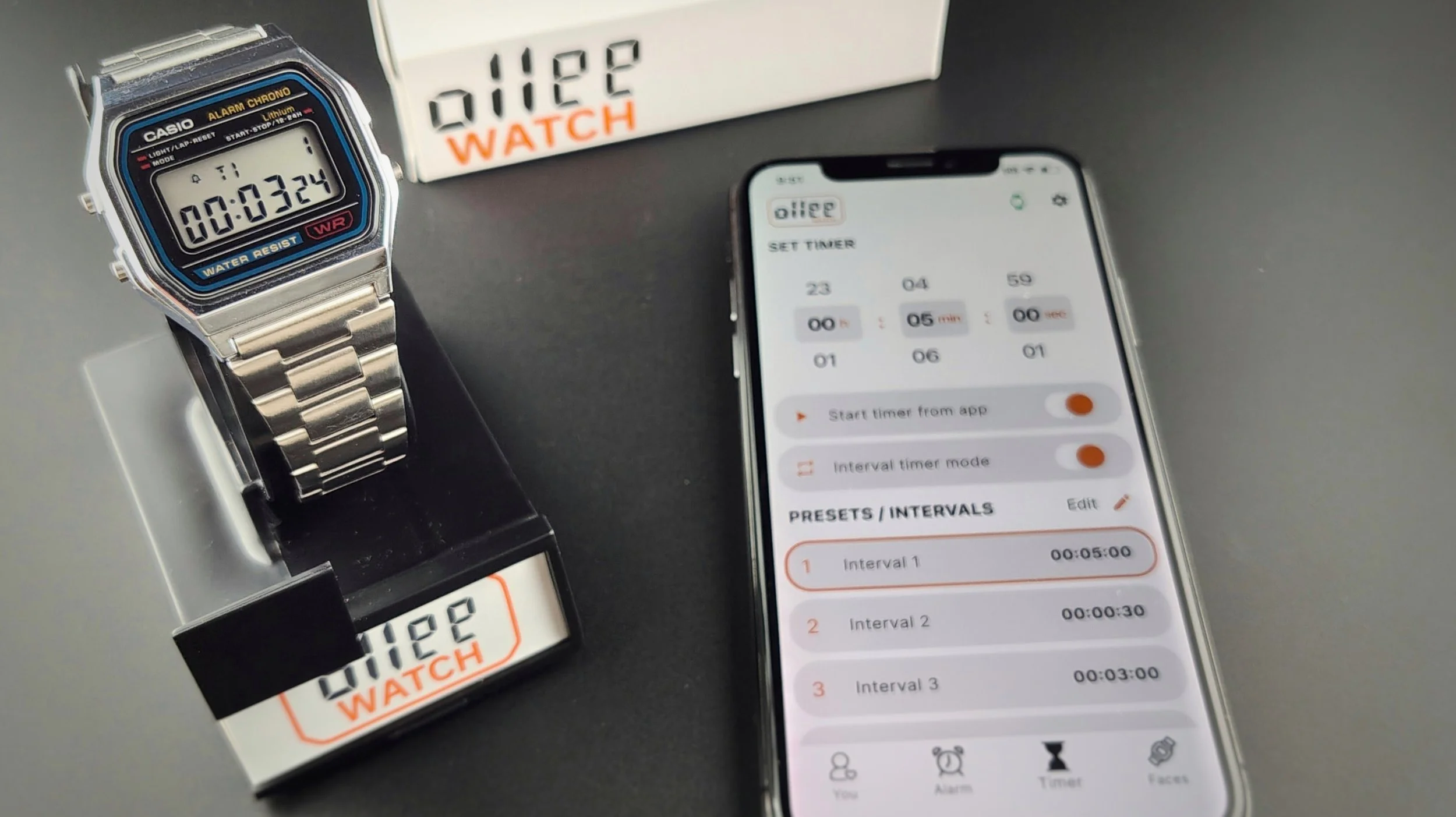
Ollee Watch is a clever modification that replaces the original circuit board inside classic Casio digital watches and turns them into something approaching a smartwatch — without destroying the thing that made them beloved in the first place.
That last part is important.
The world is full of technology that improves objects by erasing their souls.
Ollee seems to understand that the Casio must remain Casio.
The Sleeper Smartwatch
In car culture, a sleeper is a machine that looks ordinary from the outside but hides something far more interesting beneath the surface. A plain old sedan with an engine that can embarrass louder beasts. A quiet creature with sharp teeth.
That is exactly what Ollee Watch does to the F-91W and its relatives.
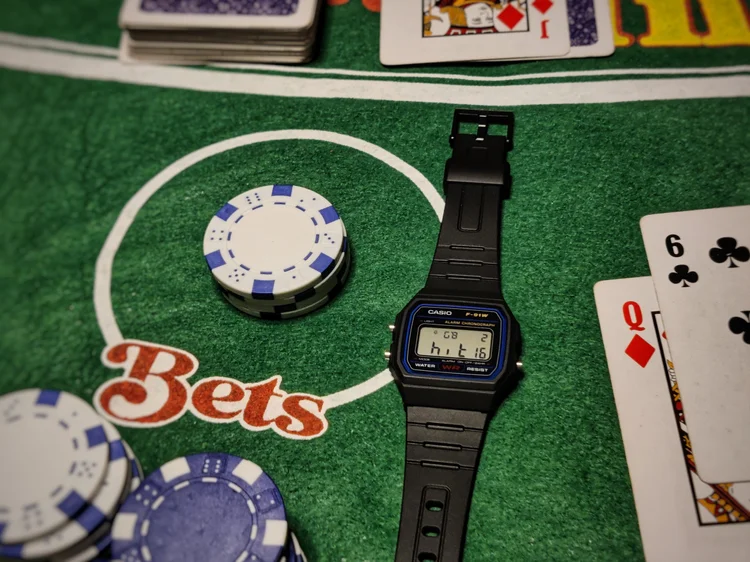
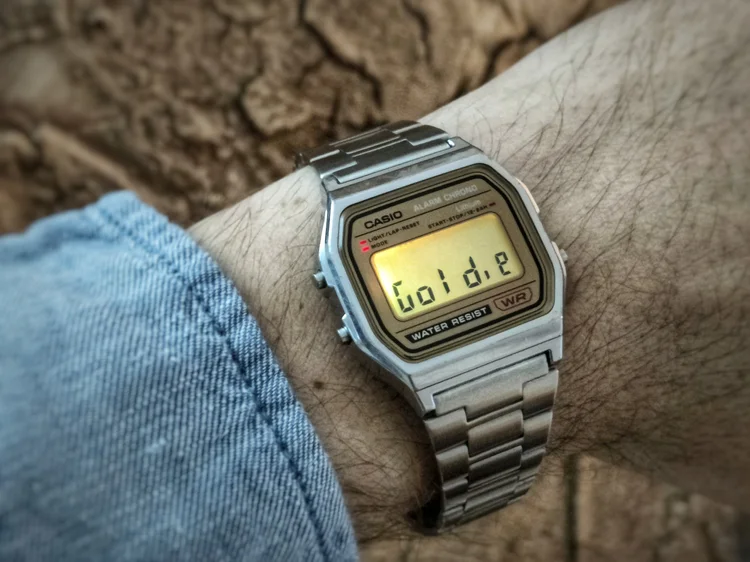
From the outside, your Casio still looks like the same familiar little digital watch. The black resin case, the square face, the tiny display, the humble proportions — all remain. The A158W keeps its retro metal bracelet charm. The F-91W keeps its schoolyard, workshop and travel-watch honesty.
But inside, the old brain is gone.
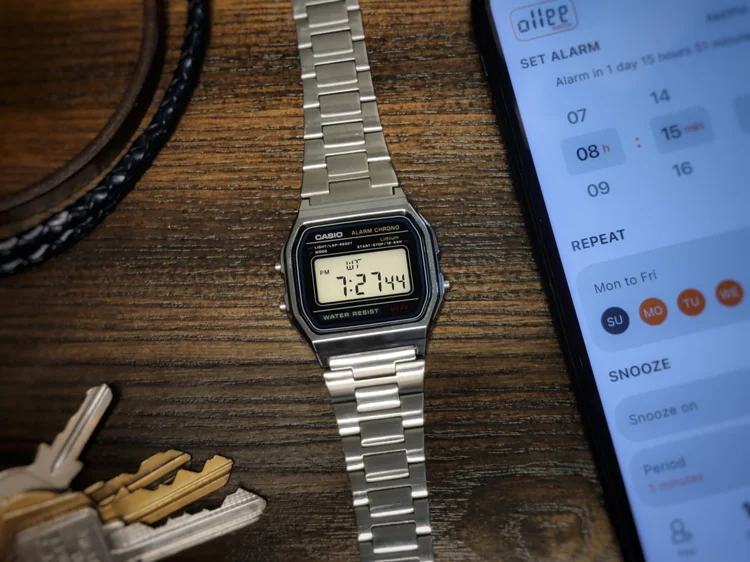
In its place sits a new module with Bluetooth Low Energy, motion sensing, RGB backlight, app connectivity, data storage, firmware updates and a surprising list of modern functions. Time can be synced from your phone. World time becomes easier. Alarms gain more personality. The stopwatch can log activity. A timer appears. Sunrise and sunset can be displayed. Steps can be tracked. Temperature can be logged. Games can even be played on that tiny old screen.
This is not an Apple Watch.
Thank heavens.
It is something more peculiar: a Casio that has been secretly educated.
The Beauty of Not Changing the Face
The most intelligent decision Ollee makes is leaving the watch visually familiar.
There is temptation in all modernisation. Add a bigger display. Add touch. Add notifications. Add more glass. Add more glow. Add so much intelligence that the object forgets how to be charming.
Ollee resists that temptation.
The original Casio LCD remains part of the experience. The old case remains. The basic three-button language remains. This matters because the F-91W is not merely a platform. It is an icon of restraint. Its value lies in the fact that it gives you enough and then stops.
A normal smartwatch wants your attention.
A Casio gives you the time and leaves you alone.
Ollee’s cleverness is that it adds ability without turning the watch into a needy little rectangle on the wrist. It is still quiet. Still small. Still wonderfully unimportant to strangers.
Only the wearer knows what has changed.
I admire that.
There is an old pleasure in hidden power.
Bluetooth Without the Tyranny of Notifications
One of the most refreshing things about Ollee Watch is what it does not try to become.
It does not seem designed as another notification machine. It is not there to drag messages, meetings, vibrations and digital anxiety onto the wrist. Instead, it uses Bluetooth in a more civilised way: to keep time synced, to manage settings, to connect with an app, to store and view activity data, and to make the old Casio easier to live with.
That is a wiser form of smartness.
Mortals have confused intelligence with interruption. They wear devices that buzz like anxious insects and then wonder why silence has become rare. A truly smart watch should not merely tell you everything. It should know what to leave unsaid.
Ollee Watch feels closer to that philosophy.
It modernises the Casio without turning it into a small master.
Fitness, But in the Casio Way
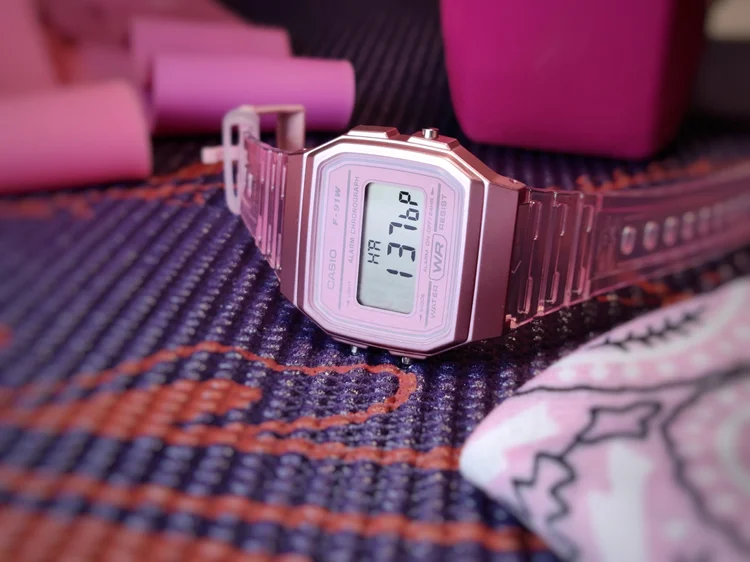
Ollee adds step tracking, daily goals, activity history, Apple Health and Google Health Connect support, and even heart-rate measurement through a pulsometer technique.
This is not the same as having an optical heart-rate sensor glowing against the wrist like a tiny medical lantern. It is more modest, more manual, more in keeping with the limitations of the platform.
And that is fine.
The charm of this project is not that it turns a £20 or $20 digital watch into a high-end fitness computer. It does not. The charm is that it gives the old watch useful modern abilities while respecting the absurdly small stage on which those abilities must perform.
A step counter inside an F-91W feels almost mischievous.
Like finding a library hidden inside a matchbox.
RGB Light and Retro Play
The RGB backlight may be one of the most emotionally satisfying additions.
The original F-91W light is famous, but not always for the right reasons. It is dim, uneven and more suggestive than helpful. It has its charm, of course, but that charm is partly comic. Ollee gives the watch colour and personality through an RGB LED backlight, allowing the wearer to customise the glow.
This is where the modification becomes playful.
Custom name tags, faces, favourite apps, alarm sounds, games such as Ping, Blackjack and Poker — these are not essential. Nobody needs Blackjack on a Casio.
But need is not the point.
Watch collecting itself often has little to do with need. It is about attachment, memory, delight, identity and the small private ceremonies we build around objects. A little game inside a tiny retro digital watch is ridiculous.
That is precisely why it works.
Battery Life: The Old Virtue Preserved
A great danger with any smart modification is battery life.
The old Casio is loved partly because it barely asks for anything. It runs and runs, forgotten until the strap breaks or the battery finally gives up after years of service. A smartwatch, by contrast, often lives like a nervous pet: feed me tonight, feed me tomorrow, feed me again.
Ollee claims up to 10 months of battery life with daily usage and default settings, or more than three years in power saver mode with motion sensing off.
That is vital.
A Casio that needs charging every night is no longer a Casio in spirit. It becomes a costume. Ollee appears to understand that the original virtue of low-maintenance timekeeping must survive the operation.
The patient has been modified.
But the heartbeat remains slow.
A Mod, Not a Replacement
There is something philosophically interesting about Ollee Watch. It is not a new watch trying to replace the old Casio. It is a module that lives inside it. That makes it closer to restoration, modification and hacking than ordinary product design.
This matters because many of us already have old watches lying in drawers. Digital watches especially can become ghosts of earlier lives: school exams, first jobs, old holidays, cheap airport purchases, watches bought because one needed the time and nothing more.
Ollee gives such watches a second act.
There is a kind of tenderness in that.
The modern world is too quick to discard. New model, new screen, new battery, new subscription, new anxiety. But here is a small object saying: keep the old case, keep the old face, keep the old charm — only replace the hidden mind.
A vampire can respect such thinking.
After all, some of us have been wearing old forms with altered interiors for centuries.
Compatibility and the Casio Family
Ollee Watch is designed around several classic Casio models, including the F-91W and A158W, and tested with other models such as the F-84W, A159W, A171W, W-59, A163W and A164W. The site also notes compatibility with watches using Casio Module 593.
That choice is sensible.
These are not rare museum pieces. They are everyday digital icons, cheap enough to experiment with, familiar enough to matter, and common enough that a modification culture can form around them.
The F-91W is the obvious hero: light, slim, resin-cased, practical and iconic. The A158W gives the concept a more metallic, retro-dress personality. One becomes the smart plastic sleeper. The other becomes the smart vintage bracelet watch.
Neither loses its essential identity.
And that is the victory.
The Vampirsky View
Ollee Watch is not important because it makes a Casio “smart”.
It is important because it asks a better question: can old digital objects be made modern without becoming soulless?
The answer, at least here, appears to be yes.
This is not haute horlogerie. There are no hand-polished bevels, no Geneva stripes, no tourbillon spinning like a trapped insect beneath sapphire. But watch culture is larger than luxury. It includes the mechanical and the electronic, the expensive and the humble, the handmade and the hacked.
The F-91W belongs to mankind in a way few watches do. It is one of the democratic objects of timekeeping. Students wore it. Soldiers wore it. Travellers wore it. Workers wore it. Collectors bought it again after spending thousands on watches that did less with more drama.
To place a new brain inside such a watch is not sacrilege.
It is folklore becoming firmware.
Final Thoughts
Ollee Watch may not satisfy the purist who wants his Casio exactly as it left the factory. That is understandable. Purists guard memory, and memory deserves guardians.
But for the curious, the tinkerer, the retro-tech romantic and the collector who enjoys a secret, Ollee is a delightful idea.
It does not make the F-91W luxurious.
It makes it stranger.
It does not make the A158W expensive.
It makes it clever.
It does not turn a Casio into an Apple Watch.
It turns a Casio into a Casio from a parallel future, one where the old digital watch survived long enough to learn Bluetooth, count steps, change its light, play games and still look like it might have been bought from a corner shop in 1994.
That is a wonderful little rebellion.
Most smartwatches try to look futuristic.
Ollee Watch does something far more interesting.
It hides the future inside the past.